
Every studio has the same three or four families. The fee was due on the 1st, it is now the 15th, and the WhatsApp reminder you sent sits with two blue ticks and no reply. You do not want to be the person who chases parents for money every month - but a studio that runs on goodwill instead of a policy eventually runs out of both.
- A late fee policy only works with four fixed parts: one due date, one grace period, one flat late fee amount, and one reminder channel - stated upfront and applied the same way every time.
- The real cost of a late payment is rarely the ₹300 to ₹500 owed - it is the hours spent noticing it, remembering to follow up, and the awkward message you send anyway.
- Send the friendly reminder before the due date, not after it. Most late payments are forgetfulness, not refusal.
- Track dues as they happen, not at month-end, or the studio finds out about a shortfall three weeks too late.
What actually counts as a late fee payment?
A payment is late once it crosses your stated grace period after the due date - not the moment the calendar flips. Most Indian studios set fees due on the 1st with a 3 to 7 day grace window, because UPI transfers, salary dates and simple forgetfulness all vary by a few days.
The grace period matters more than most owners think. Without one, "late" technically starts the day after class resumes, and you end up sending reminders to parents who were always going to pay within the week anyway. That trains parents to ignore your first message, because it stops meaning anything. A short, fixed window fixes this - see how we price dance classes in India for where the due date usually sits in the billing cycle.
Why late fees quietly cost studios more than the amount owed
The real cost of a late payment is not the ₹300 or ₹500 you are short - it is the time spent noticing it is missing, remembering to follow up, and the mildly awkward message you have to send anyway. Multiply that across four or five families every month and it becomes a part-time job nobody signed up for.
We have watched studios lose more to this pattern than to actual non-payment. A ₹500 fee left untracked for three weeks does not just cost ₹500 - it costs an evening re-checking a notebook, a slightly tense conversation at pickup, and sometimes a parent who quietly decides the studio only reaches out when money is due. Unresolved fee friction is also one of the quiet reasons students "take a break" and never come back - it shows up early in dropout patterns worth watching for, and it is one of the six numbers that reveal whether a studio is actually healthy.
This is exactly why fees need to be visible the moment they slip, not discovered at month-end. StudioPartner logs every UPI and cash payment as it comes in and flags a due the day it is missed, instead of waiting for a manual reconciliation to catch it - see how it fits into StudioPartner's pricing. Sending that reminder is still a manual WhatsApp click on Basic; StudioPartner Pro sends it automatically on the schedule you set, which is one less thing on the list every single month.
How to set a late fee policy that actually holds
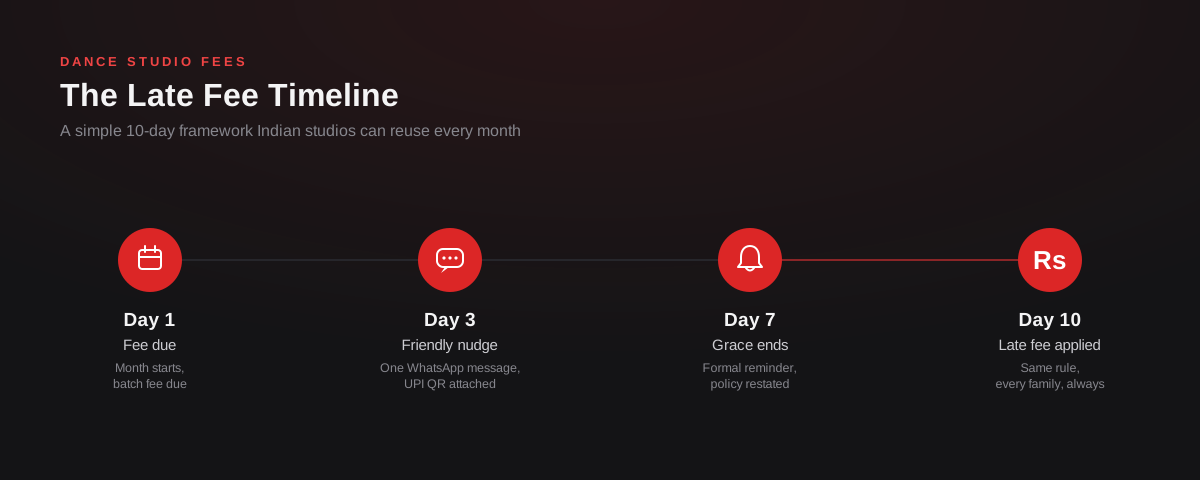
A policy holds when it has four fixed parts, decided before anyone joins: one due date, a short grace period, one clearly stated late fee amount, and one channel for reminders. Write it into your enrollment form or a pinned WhatsApp message once, and apply it exactly the same way to every family, every month.
- Pick one due date for everyone - the 1st is simplest. Per-family arrangements multiply into chaos within a term.
- Set a grace period of 3 to 7 days before anything counts as late.
- Decide the late fee amount upfront - a flat ₹100 to ₹300 is common, not a percentage you have to calculate case by case.
- Put it in writing once, in the admission form, a pinned WhatsApp message, or your invoice format - our free fee receipt and tracker templates cover both.
- Apply it the same way every time. An inconsistent policy is worse than no policy - parents stop trusting the amount, not just the deadline.
One due date
Same day every month, printed on the invoice, no exceptions.
A fixed amount
Stated upfront - not decided case-by-case once someone is already late.
A grace window
3 to 7 days, so one delayed UPI transfer does not trigger a fight.
One reminder channel
WhatsApp only - not four channels parents have to guess between.
What to say when reminding a parent, without sounding rude
The first reminder should read like a helpful nudge, not a demand - a short WhatsApp message with the amount, the UPI QR or number, and the due date, sent a day or two before the deadline. The second reminder, sent only once the grace period ends, can be shorter and firmer, because the parent already had the friendly version.
A day-3 reminder can be as simple as: "Hi! Quick reminder - March fee of ₹2,500 for [Student] is due by the 5th. UPI: studio@upi. Let us know if you've already paid, it happens." A day-8 reminder, sent after the grace period, states the policy without apologising for it: "Hi, March fee for [Student] is still pending and now includes the ₹200 late fee as per our policy. UPI: studio@upi. Please confirm by tomorrow."
Send both from the studio's number or account, never a personal chat with a parent you are also friendly with - it keeps the message about the policy, not the relationship. This is one piece of a bigger system; see our full approach to parent communication without WhatsApp chaos. It also helps that the channel is already where parents are: UPI alone processed over 24,000 crore transactions across India in FY26 (IBEF, citing NPCI data), so a reminder with a UPI link lands somewhere parents already check daily.
When should you actually enforce the late fee?
Enforce it for the routine cases - forgetfulness, disorganisation, the family that is late every single month - because that is exactly what the policy exists for. Waive it, once, for a genuine one-off like a job loss or a medical emergency, and say so explicitly, so it reads as a decision and not a loophole everyone can quietly expect.
This is also where a policy protects the relationship instead of straining it. When the same two families set the norm for everyone else, the studio ends up either resentful or broke. A rule applied evenly, every time, removes the guesswork - the studio does not have to decide fresh each month who gets flexibility and who does not. It is worth reading alongside when spreadsheets and WhatsApp actually stop being enough for fee tracking generally.
A late fee policy is not about the money. It is about never having the same awkward conversation twice.
FAQs
Should I charge a late fee if a parent is genuinely struggling financially?
No. Waive it for a real one-off situation, but say so out loud so it reads as a decision, not a rule the family can quietly expect every month. Keep the policy itself reserved for chronic lateness, not hardship.
How much should a dance studio charge as a late fee in India?
Most Indian studios charge a flat ₹100 to ₹300, not a percentage of the fee. It is easier to state, easier for parents to remember, and does not feel punitive on a ₹1,500 monthly fee the way a 10 percent penalty would.
Should I remind parents over WhatsApp or call them?
WhatsApp for the first two reminders - it is asynchronous, keeps a written record, and does not put anyone on the spot. Call only once a family has gone fully unresponsive past the grace period, since a call at that point usually means something else is going on.
Will a strict late fee policy drive parents away?
An inconsistent one will. Parents who watch other families get away with lateness lose trust in the studio, not the policy. A policy stated upfront and applied evenly rarely causes dropouts on its own - silence and surprise fees do.
What to do first
Pick your due date, grace period, and late fee amount today, even if the numbers are rough - a stated policy beats no policy immediately. Write it once into your enrollment form or a pinned WhatsApp message, decide your reminder timing, and give it one full month before you judge whether it worked. For the tracking side of this, see how we handle fees without spreadsheets and how it connects back to running the rest of the studio's systems.
Run your whole studio from one place.
StudioPartner handles students, fees, attendance, batches and leads, built for Indian dance studios. Free forever for up to 30 students, no card required.
Start free